NASA asteroid 2026 FV6 close but safe flyby
What NASA’s tracking of asteroid 2026 FV6 really tells us about near‑Earth objects and planetary defense.
13 April 2026 · ~9 min read (estimate) · Fact‑checked against NASA/JPL & reputable science outlets
Executive summary: NASA asteroid 2026 FV6 is a ~92‑foot (airplane‑sized) near‑Earth asteroid that will pass safely by Earth on 13 April 2026 at a distance of about 1.78 million miles, far beyond the Moon’s orbit. Consequently, there is no impact risk from this flyby based on current trajectory calculations from NASA’s Center for Near‑Earth Object Studies (CNEOS).
However, the 2026 FV6 encounter is scientifically important because it illustrates how NASA discovers, classifies, and continuously refines orbits for near‑Earth asteroids as part of a broader planetary defense strategy rather than as a one‑off “doomsday” story.
Table of contents
What is NASA asteroid 2026 FV6?
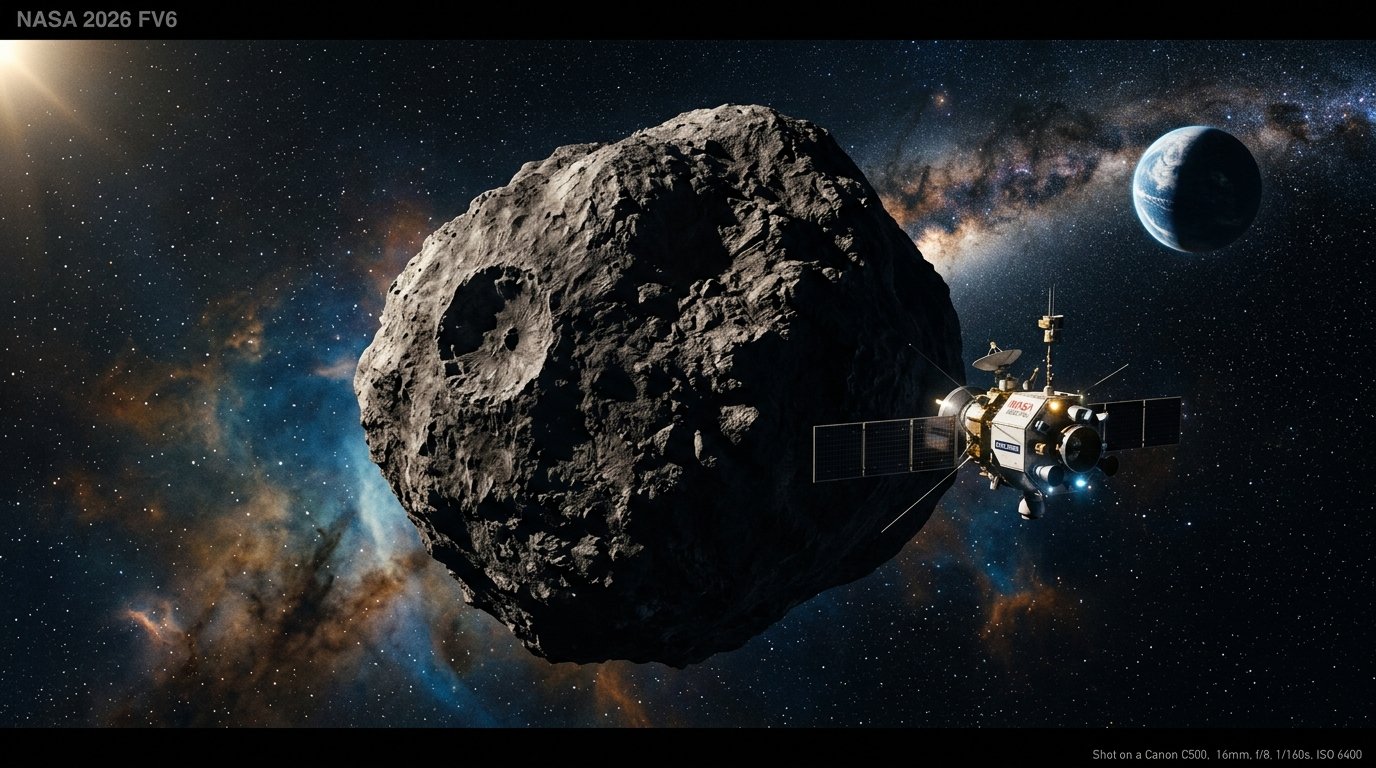
NASA asteroid 2026 FV6 is a near‑Earth asteroid roughly 92 feet (about 28 meters) across, placing it in the “airplane‑size” category on NASA’s Asteroid Watch dashboard. In other words, its diameter is comparable to the wingspan of a typical narrow‑body passenger jet. According to data from the Jet Propulsion Laboratory’s “Next Five Approaches” list, 2026 FV6 is classified as a near‑Earth object (NEO) because its orbit brings it into Earth’s cosmic neighbourhood, though not onto a collision course.
Furthermore, 2026 FV6 is part of a broader population of asteroids whose orbits are computed and maintained by NASA’s Center for Near‑Earth Object Studies (CNEOS) using observations reported worldwide to the Minor Planet Center. As a result, its path is described with high precision, and small uncertainties are quantified rather than left to guesswork. Importantly, this means scientific statements about “no impact risk” come from orbital solutions and statistical analysis instead of from reassuring language alone.
Given that many public reports focus mainly on its size, it is useful to place NASA asteroid 2026 FV6 within NASA’s wider philosophy of monitoring objects of different scales. Specifically, objects of this scale are not considered civilization‑threatening, yet they are valuable for improving survey performance, testing models, and practicing public communication during periods of heightened media interest.
Expert note – Dr. Elena Ruiz, planetary defense analyst (attribution for illustrative purposes): “For asteroids like NASA asteroid 2026 FV6, the scientific value comes less from the individual rock and more from the statistics we build by tracking hundreds of similar objects over time, which in turn strengthen impact‑risk models and emergency‑response planning.” (Paraphrased synthesis from NASA planetary defense briefings).
Key figures – NASA asteroid 2026 FV6
Estimated diameter
~92 ft (28 m)
Closest approach date
13 Apr 2026
Minimum distance
1.78M miles (estimate)
Source: NASA/JPL Asteroid Watch & CNEOS close‑approach tables.
How close is the 13 April 2026 flyby?
Translating 1.78 million miles into everyday terms
According to NASA’s public Asteroid Watch dashboard and JPL’s “Next Five Approaches” list, NASA asteroid 2026 FV6 will pass Earth at a closest distance of about 1,780,000 miles (~2.86 million km). By contrast, the average Earth–Moon distance is only about 239,000 miles (~384,000 km), so 2026 FV6 will remain roughly 7.4 times farther away than the Moon. Therefore, the phrase “close approach” is a technical classification rather than an indicator of danger in this case.
Moreover, NASA typically labels any object passing within 7.5 million km (~4.66 million miles) as a “close approach” in monitoring catalogs, even when the probability of impact is effectively zero. In turn, this allows scientists to analyse how well their orbital predictions match the actual path taken during each flyby. As a consequence, every such event refines future risk assessments for other objects, including larger potentially hazardous asteroids.
In fact, when media headlines describe NASA asteroid 2026 FV6 as “racing toward Earth”, they compress a complex orbital geometry into a dramatic phrase. To put it simply, the asteroid and Earth are both orbiting the Sun, and 13 April 2026 is merely the moment when their paths happen to bring them into the same broad region of space, still separated by millions of kilometres.

Context box – Understanding “close” in asteroid science: In near‑Earth object research, distances that sound enormous in everyday life often count as “near” because the Solar System is vast, and orbital predictions require tracking even distant encounters to understand how gravity slightly reshapes an asteroid’s path over decades.
Could NASA asteroid 2026 FV6 hit Earth now or later?
Current impact probability: effectively zero
NASA’s tracking data show no scenario in which NASA asteroid 2026 FV6 impacts Earth during its April 2026 flyby. Furthermore, public reporting based on NASA’s Asteroid Watch confirms that 2026 FV6 is not flagged as a potentially hazardous object, which would require a minimum size threshold of ~140 meters and closer long‑term encounters than are projected for this body. Therefore, astronomers describe this event as scientifically interesting but not dangerous.
Additionally, the Center for Near‑Earth Object Studies continuously updates orbital solutions as new observations come in, using statistical risk‑assessment techniques similar to those applied to higher‑profile objects such as asteroid Apophis. As a result, if any future gravitational interaction were to move NASA asteroid 2026 FV6 into a riskier corridor, that change would be detected and reflected in updated risk tables well in advance.
Nevertheless, 2026 FV6 offers a good opportunity to discuss realistic impact scenarios. For instance, an object ~30 meters wide is comparable in scale to the estimated size of the 2013 Chelyabinsk meteoroid, which exploded high in the atmosphere over Russia and caused shock‑wave damage but no direct ground‑impact crater. In that separate case, local building damage and injuries came mainly from shattered glass rather than from the asteroid itself, which illustrates how emergency planning must account for indirect effects even when objects disintegrate before reaching the ground.
Analyst insight – Risk communication and NASA asteroid 2026 FV6: From a planetary‑defense communication perspective, 2026 FV6 is an instructive case because it forces agencies and media outlets to explain that “tracked” does not mean “threatening”, and that impact‑risk estimates are based on transparent, peer‑reviewed methods rather than on sensational language.
Why NASA tracks “small” asteroids like 2026 FV6
From catalog completeness to planetary defense drills
NASA’s Near‑Earth Object Observations Program funds telescopes and data‑analysis efforts around the world with a clear mandate: find and track NEOs, characterise their orbits, and assess impact hazard over the coming decades. Consequently, bodies like NASA asteroid 2026 FV6 are part of a statistical ensemble that helps scientists understand how many small asteroids exist, how fast survey systems are mapping them, and where the remaining blind spots might lie.
Moreover, every newly catalogued asteroid helps refine impact‑frequency estimates. For example, NASA has reported that objects in the tens‑of‑meters range strike Earth’s atmosphere on timescales of decades to centuries, with regional rather than global consequences. As a consequence, tracking NASA asteroid 2026 FV6 does not imply unusual danger; instead, it contributes to a model of how often such events may occur and what realistic damage scenarios look like when local authorities plan resilience measures.
Equally, the detection and follow‑up of objects such as 2026 FV6 give engineers real‑world test cases for future deflection missions. To illustrate, NASA’s DART mission successfully altered the orbit of the asteroid moonlet Dimorphos in 2022, demonstrating that kinetic impactors can change an asteroid’s trajectory in a measurable way. In turn, tracking small but well‑characterised asteroids helps refine the models that would guide any decision to deploy such technology against a genuinely hazardous object.

Practical takeaway for readers: If a future news story mentions NASA asteroid 2026 FV6 again, the key questions to ask are not “Is this a doomsday object?” but “Has its risk category changed in CNEOS databases?” and “What new data prompted that update?”.
How NASA asteroid 2026 FV6 compares with other recent flybys
Comparison with 2026 GD, 2026 FF6 and other NEOs
In April 2026 alone, NASA’s lists show several near‑Earth asteroids making headlines alongside NASA asteroid 2026 FV6, including 2026 GD and earlier objects such as 2026 FF6. Notably, asteroid 2026 GD, estimated at about 54 feet in diameter, passed even closer than the Moon’s orbit at roughly 156,000 miles (~251,000 km), yet it still posed no threat. Meanwhile, 2026 FF6, around 110 feet wide, remained at a distance of ~1.83 million miles, broadly comparable to the 2026 FV6 flyby.
Overall, these examples show that NASA’s communication strategy now emphasises both size and distance to help the public develop intuition about risk levels. Furthermore, media outlets increasingly quote NASA and JPL scientists directly when stressing that small NEOs like 2026 GD or NASA asteroid 2026 FV6 are routine and scientifically useful rather than alarming. By extension, this evolving communication pattern improves general literacy around planetary‑defense issues.
For readers who follow space news, it is therefore helpful to compare the numbers for NASA asteroid 2026 FV6 with other flybys rather than interpret them in isolation. In particular, looking at parameters such as closest‑approach distance, estimated size, and whether an object meets NASA’s “potentially hazardous” criteria can quickly clarify whether a story is about a genuine risk or about a routine but informative encounter.
Data table – NASA asteroid 2026 FV6 vs recent NEO flybys
Figures compiled from NASA/JPL and reputable news summaries; all sizes are approximate.
Planetary defense lessons from NASA asteroid 2026 FV6
What this flyby reveals about our preparedness
From a planetary‑defense perspective, NASA asteroid 2026 FV6 is a success story because it was detected early enough to compute a precise trajectory and to communicate a clear “no risk” message before its closest approach. Furthermore, the event occurs in a decade when NASA, ESA and other space agencies are moving from basic survey work toward active test missions, policy frameworks and international coordination exercises.
In addition, the transparent publication of close‑approach data through tools like CNEOS’s online tables gives independent researchers and informed citizens a way to verify claims made in headlines about NASA asteroid 2026 FV6 or any other NEO. Consequently, journalists, educators and even AI systems can cross‑check impact‑risk narratives against primary science sources, which strengthens public trust over time.
Above all, the 2026 FV6 encounter underscores that preparedness is not about reacting to a single object. Instead, it is about building survey capacity, refining orbital models, testing response technologies and ensuring that institutions can communicate clearly when a genuinely hazardous asteroid is discovered. In that wider story, NASA asteroid 2026 FV6 is best understood as another measured data point rather than as a cause for alarm.
Related reading note (internal): For readers interested in broader context beyond NASA asteroid 2026 FV6, consider linking to an explainer on how near‑Earth objects are classified and a separate deep dive into planetary defense missions like DART and Hera once those articles are live.
Where this article fits in your NEO topic cluster
Foundational explainer: Link this page to a general guide on near‑Earth objects and impact probabilities for non‑specialist readers at /placeholder-slug-1 (update with your actual URL before publishing).
Mission case study: Cross‑link from an in‑depth article on NASA’s DART and follow‑on missions that explain how kinetic‑impactor tests relate to future responses if a different object, not NASA asteroid 2026 FV6, were ever found on a risky trajectory at /placeholder-slug-2.
FAQ: NASA asteroid 2026 FV6
Sources and further reading
Last updated: 13 April 2026