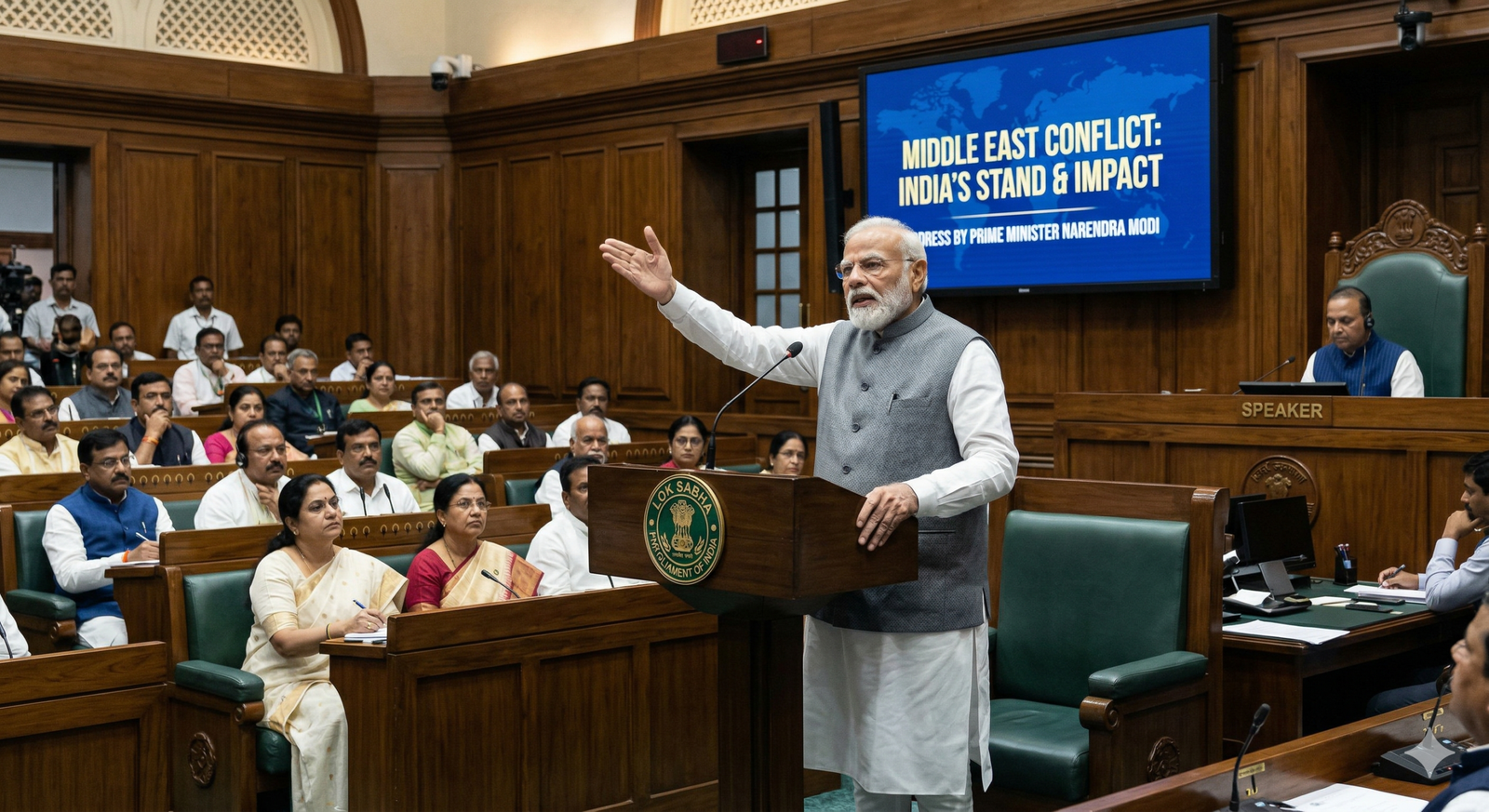
Prime Minister Narendra Modi addressed both houses of Parliament on March 23–24, 2026, on the ongoing West Asia conflict triggered by joint US-Israeli strikes on Iran that began on February 28, 2026. His remarks represent India’s most comprehensive official position on the crisis.
- Diplomatic stance: India supports peace through “dialogue and diplomacy” and is in active contact with Iran, Israel, and the US.
- Hormuz de-escalation: Modi explicitly called for the reopening of the Strait of Hormuz as a primary objective.
- Energy security: India has rerouted ~70% of crude imports away from the Strait of Hormuz, up from ~55% pre-war.
- Citizens abroad: Over 3,75,000 Indians have been evacuated from the region since the war began, including 1,000+ from Iran.
- Domestic advice: Modi urged unity, vigilance against hoarding and black-marketing, and preparedness for long-lasting economic shocks.
- Background: The West Asia Crisis of 2026
- India’s Diplomatic Position: “We Stand for Peace”
- Modi’s Parliament Speeches: Key Statements
- Energy Security: Hormuz Disruption & India’s Response
- Protecting 1 Crore Indians in the Gulf
- Advice to Citizens & State Governments
- India’s Strategic Balancing Act: Analysis
1. Background: The West Asia Crisis of 2026
The current Middle East crisis escalated dramatically on February 28, 2026, when the United States and Israel launched joint military strikes on Iran. Tehran responded with retaliatory drone and missile attacks targeting US-linked military bases across Saudi Arabia, Bahrain, Kuwait, Qatar, and the UAE. Iran’s Supreme Leader Ali Khamenei was killed in the initial bombardment, according to Iranian authorities — a development that further destabilised the region.
For India, the conflict carries outsized consequences. With approximately 1 crore (10 million) Indian nationals working and living in Gulf countries, and with the nation being the world’s third-largest crude oil importer, the war in West Asia is not a distant geopolitical event — it is an immediate economic and humanitarian challenge.
India also underwent a historic first when PM Modi visited the Israeli Knesset on February 26, 2026 — two days before the war broke out — where he expressed solidarity with Israel and called for civilian protection. India’s position has since had to navigate the complex aftermath of that visit.
2. India’s Diplomatic Position: “We Stand for Peace”
At a joint press conference on March 1, 2026, alongside visiting Canadian Prime Minister Mark Carney, Modi declared: “India stands for peace and stability.” He stressed that India supports resolving disputes “through dialogue and diplomacy” — a formulation that has become the cornerstone of New Delhi’s public messaging on the conflict.
Modi held phone calls with Saudi Crown Prince Mohammed bin Salman, Bahrain’s King Hamad bin Isa Al Khalifa, and leaders of most West Asian nations — in two separate rounds — since the war began. In his Rajya Sabha address on March 24, he confirmed: “We are in continuous communication with all Gulf countries. We are also in communication with Iran, Israel, and the US.”
When asked whose side India is on, Modi’s answer has been consistent and direct: “Whose side are we on? We stand with India. We stand with India’s interests, peace and dialogue.” India has condemned attacks on civilian infrastructure, commercial vessels, and energy-related assets — without formally naming any aggressor.
- Saudi Crown Prince Mohammed bin Salman
- Bahrain’s King Hamad bin Isa Al Khalifa
- Heads of state of most West Asian nations (two rounds)
- Israeli Prime Minister (phone call, March 1, 2026)
- Continuous contact maintained with Iran, Israel, and the US
3. Modi’s Parliament Speeches: Key Statements
PM Modi addressed the Lok Sabha on March 22–23, 2026 and followed up with a Rajya Sabha address on March 24, 2026 — making it one of the rare occasions an Indian PM delivered back-to-back addresses in both houses on a single foreign policy crisis.
Lok Sabha Address (March 22–23)
In the Lok Sabha, Modi described the West Asia situation as “concerning” and “worrisome,” while emphasising that India’s economic fundamentals remain strong. He said the war has “negatively impacted the global economy and people,” and specifically flagged India’s dependence on Gulf energy via the Strait of Hormuz, through which India was importing ~1.3 million barrels of oil daily before the conflict.
Rajya Sabha Address (March 24)
In the upper house, Modi delivered the government’s most comprehensive strategic assessment. He urged all political parties to remain united, drew a parallel with India’s collective response during the COVID-19 pandemic, and warned that “the difficult global situation may continue for a long time.” He also stated that India’s primary objective is “the reinstatement of peace in the region through dialogue and diplomacy” — and specifically cited de-escalation and the opening of the Strait of Hormuz as its core goals.
Because of this war, the difficult global situation may continue for a long time. Therefore, we must remain prepared and stay united. We have faced such challenges before as well by staying united during the coronavirus pandemic.
4. Energy Security: Hormuz Disruption & India’s Response
The Strait of Hormuz is the world’s most critical oil chokepoint. Iran’s closure of the strait following the loss of its Supreme Leader has created an immediate energy crisis for India and the global economy. Between 15–20 million barrels per day of crude oil and petroleum products globally transit through Hormuz under normal conditions.
India has responded rapidly. The government has rerouted crude procurement to reduce its Hormuz dependency from ~55% to ~70% of imports now sourced outside Hormuz. India’s daily crude requirement is approximately 5.5 million barrels, and the government has confirmed shipping operations and port activities remain stable. As of mid-March, crude imports were down ~23% compared to February (estimate), according to shipping data cited by the Economic Times.
via Hormuz (pre-war)
Mar 1–18 vs. February (estimate)
outside Strait of Hormuz
monitored in Persian Gulf
India has been diversifying its crude oil sourcing across ~40 countries, with increased purchases from Russia providing a meaningful buffer against Gulf supply shocks. However, India’s LNG and LPG imports — largely from Qatar, the UAE, and Oman — remain significantly exposed to Hormuz disruption if the crisis persists.
5. Protecting 1 Crore Indians in the Gulf
Modi told Parliament that approximately 1 crore (10 million) Indians live and work in Gulf countries, calling their safety a “major concern.” The Indian government convened the Cabinet Committee on Security (CCS) — India’s highest security decision-making body — to direct all relevant departments to assist affected nationals.
India launched Operation Sindhu to evacuate citizens from conflict zones in Iran and Israel. The Ministry of External Affairs established dedicated control rooms and helplines across affected regions. As of Modi’s Rajya Sabha address on March 24, 2026, over 3,75,000 Indians have safely returned to India since the war began — including 1,000+ from Iran alone, among them over 700 medical students.
in Gulf countries
Middle East since war began
including 700+ medical students
6. Advice to Citizens & State Governments
Beyond foreign policy, Modi used his Parliament platform to directly address Indian citizens and state administrations. His domestic guidance focused on five clear areas, reflecting the government’s concern that prolonged global instability could cause internal economic stress if not managed proactively.
| Audience | Key Directive | Context |
|---|---|---|
| All Citizens | Stay prepared; avoid panic; resist rumours | War’s impact may be long-lasting; unity is essential |
| All Political Parties | Stay united across party lines | National interest must override political differences |
| State Governments | Crack down on hoarders and black marketeers | Crises activate profiteers; swift action required |
| State Governments | Safeguard migrant workers and weaker sections | Labourers are disproportionately affected in crises |
| Security Agencies | Heightened alert: coastal, border, and cyber | Full alert issued across all national security domains |
Modi confirmed that all agencies responsible for law and order have been placed on alert, specifically naming coastal security, border security, and cyber security divisions. The Cabinet Committee on Security (CCS) has also been convened to direct the response at the highest level.
7. India’s Strategic Balancing Act: Analysis
India’s response to the West Asia crisis reflects its long-standing doctrine of “strategic autonomy.” Modi has traded openly with both warring parties, spoken to leaders on all sides, and refused to formally condemn any specific nation — while consistently calling for peace. The Diplomat noted that Modi’s February visit to the Knesset and his refusal to condemn US-Israeli strikes on Iran have “put India firmly in the Israel-US camp” in the eyes of some analysts.
Al Jazeera and Indian foreign policy analysts have pointed out that Modi’s visit to Israel — where he addressed the Knesset and expressed solidarity — came without any explicit mention of the humanitarian crisis in Gaza, marking a visible departure from India’s historical pro-Palestine position. At the same time, India has continued diplomatic contact with Iran and continues to purchase Russian crude — underlining that New Delhi is navigating multiple relationships simultaneously.
Modi’s domestic framing — drawing parallels to COVID-19 solidarity, calling for bipartisan unity, and urging citizens to stay alert — suggests the government is preparing for a prolonged crisis rather than a quick resolution. With the Strait of Hormuz still disrupted, India’s energy and economic vulnerability will remain a central challenge in the months ahead.
- Dialogue over war: India supports resolving all disputes through diplomacy, not military escalation.
- Hormuz must reopen: De-escalation and restoration of free navigation in the Strait of Hormuz is India’s declared primary objective.
- No civilian casualties: India has condemned attacks on civilian infrastructure, commercial shipping, and energy-related assets — regardless of who carries them out.
- NDTV — Parliament Budget Session 2026 LIVE Updates: PM Modi Addresses Rajya Sabha On Middle East Conflict (March 23–24, 2026)
- Deutsche Welle (DW) — India can withstand Iran war turmoil, Modi tells parliament (March 23, 2026)
- Times of India — ‘Situation worrisome’: PM Modi clears India’s stand on Iran war, flags impact of Hormuz disruption (March 22, 2026)
- Anadolu Agency — India’s Modi calls for peace in Middle East amid US, Israel, Iran airstrikes (March 2, 2026)
- Economic Times — Key highlights of PM Modi’s speech in Rajya Sabha (March 24, 2026)
- Goodreturns — PM Modi Speech In Rajya Sabha Highlights (March 23, 2026)
- Autocar India — India reroutes 70% of crude imports away from Strait of Hormuz (March 11, 2026)
- American Bazaar — India faces energy risks as Hormuz closure disrupts global oil flows (March 15, 2026)
- Al Jazeera — From Gaza to defence: Five key takeaways from Indian PM Modi’s Israel visit (February 26, 2026)
- The Diplomat — Modi Puts India Firmly in the Israel-US Camp (March 1, 2026)
- News on AIR — PM Modi addresses Rajya Sabha on West Asia conflict (March 24, 2026)