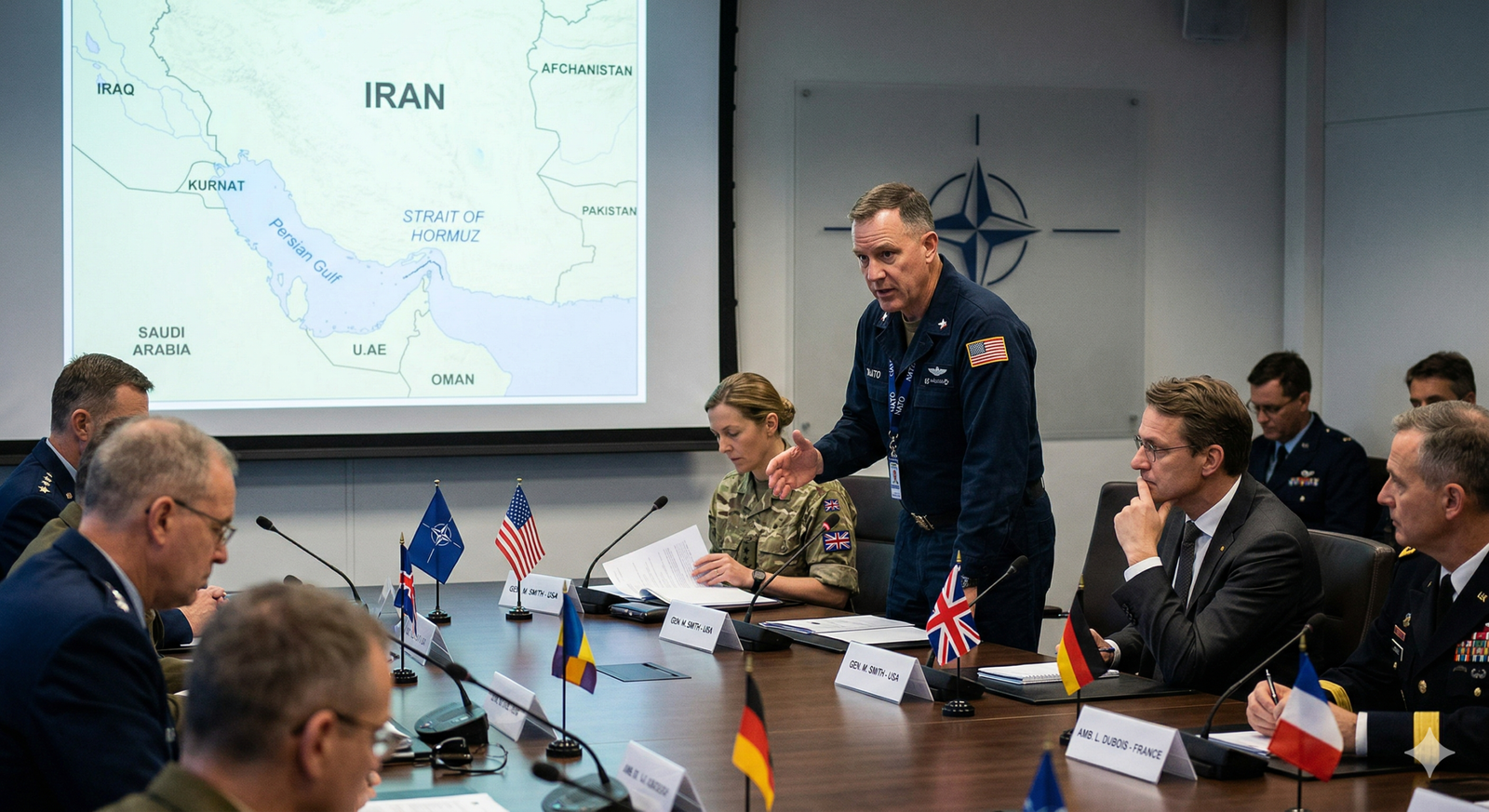
On February 28, 2026, the United States and Israel launched Operation Epic Fury — a surprise, large-scale military campaign targeting Iran’s military infrastructure, nuclear facilities, and command structures. The campaign has since struck over 7,000 targets across Iran. NATO Secretary General Mark Rutte has verbally endorsed US and Israeli actions but has drawn a clear line: the alliance itself will not participate militarily. A coalition of 22 nations — most NATO members, plus Japan, South Korea, Australia, the UAE, and Bahrain — is now coordinating to reopen the Strait of Hormuz, which Iran has effectively blockaded. Deep internal divisions have emerged within the alliance, with Spain calling the war “illegal” and the UK ruling out direct involvement. The risk of NATO’s Article 5 mutual-defence clause being triggered remains a live discussion among analysts.
1. Background: The Road to Operation Epic Fury
The 2026 conflict between the United States and Iran did not emerge overnight. It was the culmination of years of escalating tension over Iran’s nuclear program, regional proxy activities, and the Trump administration’s “maximum pressure” policy, which was reinstated in February 2025. Throughout 2025, the two countries engaged in a series of indirect nuclear negotiations in Geneva, with both sides alternating between diplomatic overtures and military threats.
On January 23, 2026, President Trump announced that a US “armada,” including the aircraft carrier USS Abraham Lincoln and several guided-missile destroyers, was heading to the Middle East. On February 13, the USS Gerald R. Ford carrier group followed. By late February, US bases across the region accommodated approximately 50,000 American troops — the largest US air force presence in the Middle East since the 2003 invasion of Iraq.
On February 25, 2026 — just three days before the strikes — Iranian Foreign Minister Abbas Araghchi declared that a “historic” agreement to avert military conflict was “within reach,” calling Iran’s position against developing nuclear weapons “crystal clear.” Talks collapsed without a deal.
Throughout 2025, the US had also conducted strikes on Iran’s Fordow, Natanz, and Isfahan nuclear facilities (June 21, 2025), following a breakdown in negotiations. Iran retaliated with counter-threats and drone attacks on US assets in the region. By early 2026, both diplomatic channels and military buildups were running in parallel.
2. Operation Epic Fury: What Happened
On February 28, 2026, US and Israeli forces launched what CENTCOM called Operation Epic Fury — a coordinated, surprise campaign of nearly 900 strikes in the first 12 hours alone, targeting Iranian missile systems, air defenses, military infrastructure, and nuclear sites. The strikes also killed Iran’s Supreme Leader Ayatollah Ali Khamenei.
The Pentagon confirmed that 5,000-pound penetrator weapons were used against underground Iranian storage facilities. Strikes also destroyed over 120 Iranian naval vessels and 44 minelayers. As of March 19, the Pentagon stated that missile attacks on US forces had dropped by 90% since the start of the conflict, attributing this to the degradation of Iran’s ballistic missile manufacturing capacity.
Iran retaliated with drone and missile strikes across Gulf countries and launched four ballistic missiles at the USS Abraham Lincoln carrier. It also moved to effectively close the Strait of Hormuz — a waterway through which approximately 20% of the world’s oil supply passes — causing immediate spikes in global energy prices and freight rates.
The Atlantic Council noted that Operation Epic Fury is “stressing critical military assets that are essential to credibly deter China,” raising broader questions about US strategic overextension in simultaneously managing two major theaters.
3. NATO’s Official Stance
NATO Secretary General Mark Rutte has walked a careful line throughout the conflict. On March 2, 2026, he commended the US and Israeli military actions, telling Germany’s ARD television that the strikes are “diminishing Iran’s ability to secure nuclear capabilities and ballistic missile technology.” However, he was equally explicit that NATO itself would not participate militarily in any capacity beyond individual allies supporting US-led operations.
Rutte’s Core Arguments
- Iran is “very close” to developing missile capabilities that could threaten Europe directly.
- Drawing a comparison with North Korea: “If we negotiate for too long, you might pass the moment where you can still get this thing done.”
- The Strait of Hormuz must reopen; 22 nations are now coordinating to achieve this.
- NATO has historically come together during crises and will continue to do so.
- Individual allies contributing to US-led operations is distinct from NATO as an institution going to war.
Rutte also acknowledged allies had needed time to prepare due to “the secrecy surrounding initial US actions” — a rare public admission that Washington had not fully consulted the alliance before launching Operation Epic Fury. President Trump, for his part, called NATO allies “cowards and paper tigers” on social media for not immediately supporting efforts to reopen the Strait of Hormuz.
“The actions being undertaken by the U.S. in collaboration with Israel are significant, as they are diminishing Iran’s ability to secure nuclear capabilities and ballistic missile technology. There are absolutely no intentions for NATO to become entangled in this situation.” — Mark Rutte, NATO Secretary General, March 2, 2026 (Reuters)
4. The Strait of Hormuz Crisis and the 22-Nation Coalition
The Strait of Hormuz — the narrow waterway between Iran and Oman through which ~20% of the world’s oil supply passes — has been effectively blockaded by Iran as retaliation for the strikes. Iran has deployed naval mines, missile-armed vessels, and issued threats to destroy energy infrastructure across the region if its nuclear or energy facilities face further strikes.
passes through the strait
On March 21–22, 2026, NATO Secretary General Rutte confirmed that a group of 22 countries had come together “since Thursday” to coordinate the reopening of the Strait. The coalition includes most NATO members as well as Japan, South Korea, Australia, New Zealand, the UAE, and Bahrain. Rutte described the group as working to answer three key questions: “What do we need? When do we need it? And where do we need it?”
22-Nation Coalition: Known Members
| Country | NATO Member | Region |
|---|---|---|
| United Kingdom | Yes | Europe |
| France | Yes | Europe |
| Germany | Yes | Europe |
| Italy | Yes | Europe |
| Netherlands | Yes | Europe |
| Canada | Yes | North America |
| Japan | Partner | Indo-Pacific |
| South Korea | Partner | Indo-Pacific |
| Australia | Partner | Indo-Pacific |
| New Zealand | Partner | Indo-Pacific |
| UAE | Partner | Gulf |
| Bahrain | Partner | Gulf |
| Note: Full list of all 22 nations not officially published as of March 24, 2026. Known members cited from Reuters, Gulf News, Korea Herald, and Axios. | ||
Allies are split on when to deploy naval forces. Some favour immediate escorts; others insist escorts must only begin after a ceasefire declaration. Rutte acknowledged: “One of the key questions is… the when question.” (Gulf News, March 22, 2026)
5. Fractures Within the Alliance
The Iran war has exposed some of the sharpest internal divisions within NATO since the 2003 Iraq War. Unlike Article 5 scenarios involving Russia — where Europe broadly aligns — operations outside NATO’s core territorial area have always been more contentious.
Alliance Positions on the Iran War
| Country / Entity | Position | Key Statement |
|---|---|---|
| NATO (Rutte) | Verbal Support, No Military Involvement | Backs US/Israel; says NATO will not participate |
| United States | Active Combatant | Leading Operation Epic Fury alongside Israel |
| United Kingdom | Non-Combatant, Hormuz Support | “Will not be drawn into a wider war” — PM Starmer |
| Spain | Opposition | Called war “illegal”; refused US use of joint bases |
| France, Germany, Italy, Netherlands, Canada | Hormuz Coalition | Signalled unity on keeping the strait open |
| Turkey | Preference to Stay Out | May consider “direct retaliation” only if specifically targeted |
Trump’s frustration with allied reluctance became public and pointed. On March 16, he warned that NATO faces a “very bad future” if allies refused to help reopen the Strait of Hormuz, and even raised the prospect of leaving the alliance — saying it was something to “think about.” European analysts view the dispute as reflecting a deeper structural tension: NATO’s collective defense commitments were designed for territorial defense, not joining US-led offensive operations outside the alliance’s borders.
“European debates have historically focused on defending NATO territory, not joining US-led operations outside the alliance’s core area.” — Anadolu Agency analysis, March 22, 2026. The dispute, analysts note, is “not just about Iran” but reflects fundamental disagreements over NATO’s strategic identity.
6. Article 5: How Real Is the Risk?
Article 5 of the NATO charter states that an armed attack against one member is considered an attack against all, obligating a collective response. It has been formally invoked only once — after the September 11, 2001 attacks. The Iran war has brought this clause back into sharp focus, particularly after Iran fired a ballistic missile that was headed toward Turkish territory in early March 2026.
Rutte explicitly stated on March 5 that NATO would not trigger Article 5 over that incident, calling a single intercepted missile an insufficient threshold. CNBC cited think-tank analyst Guntram Wolff of the Bruegel institute, who called invoking Article 5 over a single intercepted missile “a little bit exaggerated.” However, the risk calculation changes dramatically if a NATO naval vessel operating in the Strait of Hormuz coalition were directly attacked and sunk.
Invoked only once in history (post-9/11). NATO determined that a single intercepted missile headed for Turkey in March 2026 did not meet the threshold.
If Iran attacks a NATO vessel in the Strait, Article 5 could be triggered — potentially drawing 32 member states into direct conflict with Iran. Iran has issued explicit warnings about targeting the strait.
Iran has warned that if its nuclear or energy infrastructure is attacked further, it will shut down the Strait of Hormuz completely, strike energy facilities across the region, and target critical infrastructure. Iranian military officials have also stated that all US bases in nearby countries “are within reach.”
7. Iran’s Threat to Europe
One of Rutte’s central justifications for backing the US campaign is the assertion that Iran is “very close” to developing missile capabilities that could threaten Europe. Euronews reported in March 2026 that Iran’s most advanced warheads can alter their trajectory mid-descent to disrupt radar tracking, and that Iran routinely combines ballistic missiles with cruise missiles and drone swarms to overwhelm air defenses.
If Iran were to choose to strike Europe, analysts expect a multi-modal approach: precision strikes on NATO logistics hubs, economic disruption through attacks on Mediterranean port infrastructure or LNG terminals in Italy, Greece, and Romania, and cyber warfare targeting industrial control systems in water, energy, and healthcare sectors. SHAPE spokesperson Colonel Martin O’Donnell told Euronews that “Europeans should rest easy at night” — while acknowledging NATO’s official strategic threat list formally names Russia and terrorist groups, not Iran.
Under Article 42(7) of the Treaty on European Union, any attack on an EU member state legally compels all other EU member states to provide assistance — creating a parallel layer of obligations beyond NATO’s Article 5. This is particularly relevant for EU member states that are not NATO members, such as Austria and Ireland.
8. What Comes Next
The immediate focus is on the Strait of Hormuz. The 22-nation coalition has confirmed coordination is underway but “the when question” remains unresolved. Military planners are working on deployment details for minesweeping, patrols, and carrier group positioning. Trump has demanded immediate reopening; several European allies insist on a ceasefire first.
On the broader conflict, Trump predicted the war could last “four weeks” — a timeline that has already passed, with major combat operations continuing as of late March. The Pentagon’s statement that missile attacks on US forces have dropped 90% suggests significant degradation of Iranian military capacity, but the conflict remains active.
- Whether NATO’s 22-nation coalition deploys naval assets to the Strait of Hormuz — and under what conditions
- Whether Iran attacks a NATO vessel, potentially triggering Article 5
- The future of US–NATO relations if Trump follows through on threats to leave or defund the alliance
- Iran’s post-Khamenei political transition and whether a new leadership pursues negotiation or escalation
- The impact on global energy markets and whether the Strait closure triggers a broader economic crisis
- How China and Russia respond to the coalition’s Hormuz deployment
The Atlantic Council has warned that Operation Epic Fury is straining the US military assets needed to deter China in the Indo-Pacific. The Iran war is therefore not only a Middle East crisis — it is reshaping the global balance of power across multiple theaters simultaneously.
- Reuters — “NATO’s Rutte praises US, Israeli military action against Iran,” March 2, 2026
- Gulf News — “NATO chief backs US strikes, warns on Iran threat,” March 22, 2026
- Gulf News — “22 countries join drive to ensure safe Hormuz passage,” March 22, 2026
- Wikipedia — “2026 Iran war” (citing multiple primary sources)
- Wikipedia — “2025–2026 Iran–United States negotiations”
- CNBC — “The bar for Article 5 NATO action against Iran is high,” March 5, 2026
- The Hill — “NATO won’t trigger Article 5 over missile headed toward Turkey,” March 5, 2026
- Anadolu Agency — “‘All bets are off’: Could Iran war push US-NATO ties to breaking point?” March 22, 2026
- Euronews — “As Iran war reaches Europe’s borders, can the continent really rest easy?” March 11, 2026
- Atlantic Council — “Tracking US military assets in the Iran war,” March 19, 2026
- DD News (Pentagon) — “US Strikes Over 7,000 Targets in Iran Under Operation Epic Fury,” March 19, 2026
- Indian Express — “Operation Epic Fury: 3 US Troops Killed,” March 1, 2026
- Korea Herald — “22 countries, including S. Korea, forming joint response on Hormuz,” March 22, 2026
- Axios — “Seven U.S. allies back potential Strait of Hormuz coalition,” March 19, 2026
- BBC — “Who wants what from the Iran war?” March 16, 2026
- Al Jazeera — “US-Iran talks: Third round ends in Geneva,” February 26, 2026


2 thoughts on “NATO and the US–Iran War: What You Need to Know”