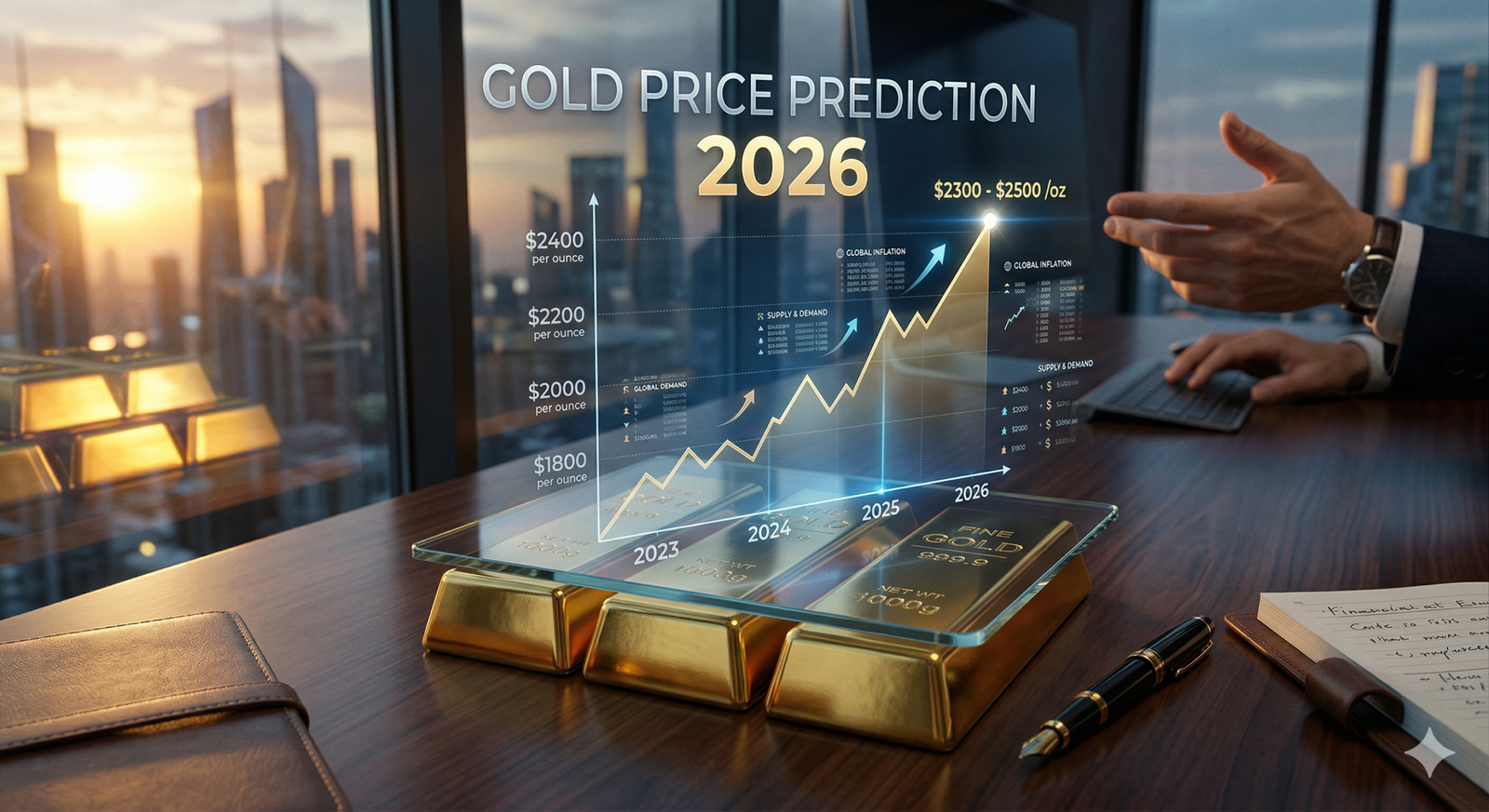
Gold Price Prediction: 2026 Outlook
Expert forecasts, global drivers, and India price scenarios
25 March 2026 · 8 min read · Fact-checked with market research reports
Gold prices remain historically elevated after strong gains in recent years. Most analysts expect moderate upside or consolidation during 2026 depending on global interest rates, currency movements, and geopolitical risks. Forecast scenarios suggest gold could average roughly $4,500–$4,700 per ounce globally and around ₹1.20 lakh per 10 grams in India (estimate), although volatility is likely throughout the year.
Table of Contents
- Current Gold Market Overview
- Expert Gold Price Forecast for 2026
- Key Factors Affecting Gold Prices
- Gold Price Forecast in India
- Bull, Base, and Bear Scenarios
- Risks and Market Uncertainties
- Should Investors Expect Long-Term Growth?
1. Current Gold Market Overview
Gold has traditionally served as a safe-haven asset during periods of inflation, financial instability, and geopolitical tensions. Over the past decade, prices have climbed significantly, with Indian gold rates crossing the ₹1 lakh per 10 g threshold during recent rallies. Analysts note that global demand from investors, central banks, and jewelry markets continues to support long-term price levels.
Gold price increase during 2025 global rally
Projected average gold price per ounce in 2026
Estimated base gold price per 10 g in India for 2026
Analysts emphasize that gold’s price movements are strongly linked to macroeconomic conditions such as inflation, currency strength, and central bank policies. Moderate volatility is therefore expected throughout 2026.
Higher interest rates often put pressure on gold prices because the metal does not generate yield. When interest rates fall, gold typically becomes more attractive as a store of value.
2. Expert Gold Price Forecast for 2026
Financial institutions and commodity analysts publish yearly forecasts for precious metals based on macroeconomic modeling. According to multiple market outlook reports, gold prices in 2026 may remain elevated but could experience periodic corrections depending on monetary policy and global economic conditions.
| Forecast Scenario | Global Gold Price (USD/oz) | India Price (₹/10 g) | Market Conditions |
|---|---|---|---|
| Bullish | ~$5,000+ | ₹1.40L–₹1.50L (estimate) | Weak dollar, strong central-bank demand |
| Base Case | $4,500–$4,700 | ~₹1.20L | Moderate growth and stable interest rates |
| Bearish | ~$4,000 | ₹1.05L–₹1.10L | Strong dollar and higher real yields |
Some analysts expect gold to deliver moderate gains of about 5–10% in dollar terms if global monetary policy loosens and investor demand stays strong.
3. Key Factors Affecting Gold Prices
Interest Rates and Inflation
Gold prices often move inversely to interest rates. When central banks raise rates to control inflation, investors may shift funds toward yield-generating assets. Conversely, lower interest rates usually boost gold demand.
US Dollar Strength
Because gold is priced globally in US dollars, a strong dollar tends to push gold prices lower internationally. A weaker dollar typically lifts gold prices.
Geopolitical Risk
Political uncertainty, wars, and economic crises historically increase demand for gold as investors seek safer assets.
During periods of financial instability, gold is often viewed as a “store of value.” This safe-haven demand can temporarily push prices higher even when other asset classes fall.
4. Gold Price Forecast in India
Gold prices in India depend not only on global prices but also on the rupee-dollar exchange rate, import duties, and domestic demand from jewelry markets. Even if global gold prices remain stable, a weaker rupee can push domestic prices higher.
| Year | Estimated Avg Price (₹/10g) | Potential Range |
|---|---|---|
| 2026 | ~₹1,20,000 | ₹1,06,900 – ₹1,47,900 |
| 2027 | ~₹1,24,000 | ₹1,06,030 – ₹1,62,040 |
| 2030 | ~₹1,36,000 | ₹1,02,657 – ₹2,04,607 |
These estimates assume moderate economic growth, continued demand from emerging markets, and stable currency trends.
5. Bull, Base, and Bear Scenarios
Bullish Scenario
Gold prices could rise sharply if global interest rates decline, geopolitical tensions increase, or central banks continue buying large quantities of gold reserves.
Base Scenario
Most analysts expect gradual growth or sideways movement with periodic volatility depending on inflation and economic indicators.
Bearish Scenario
Gold prices may decline if economic growth strengthens significantly and investors shift capital toward equities and bonds.
6. Risks and Market Uncertainties
- Unexpected monetary tightening by central banks
- Strengthening of the US dollar
- Reduced demand for jewelry and investment gold
- Policy changes affecting import duties
- Global economic recovery reducing safe-haven demand
7. Long-Term Outlook for Gold
Despite short-term volatility, many analysts consider gold a long-term portfolio hedge against inflation and economic instability. Central bank purchases, geopolitical uncertainty, and structural demand from emerging economies may continue to support prices over the coming decade.
While exact predictions are impossible, most forecasts indicate that gold prices in 2026 are likely to remain high with moderate growth potential. Investors should expect periodic corrections and maintain diversified portfolios when considering gold as an asset.