Executive Summary
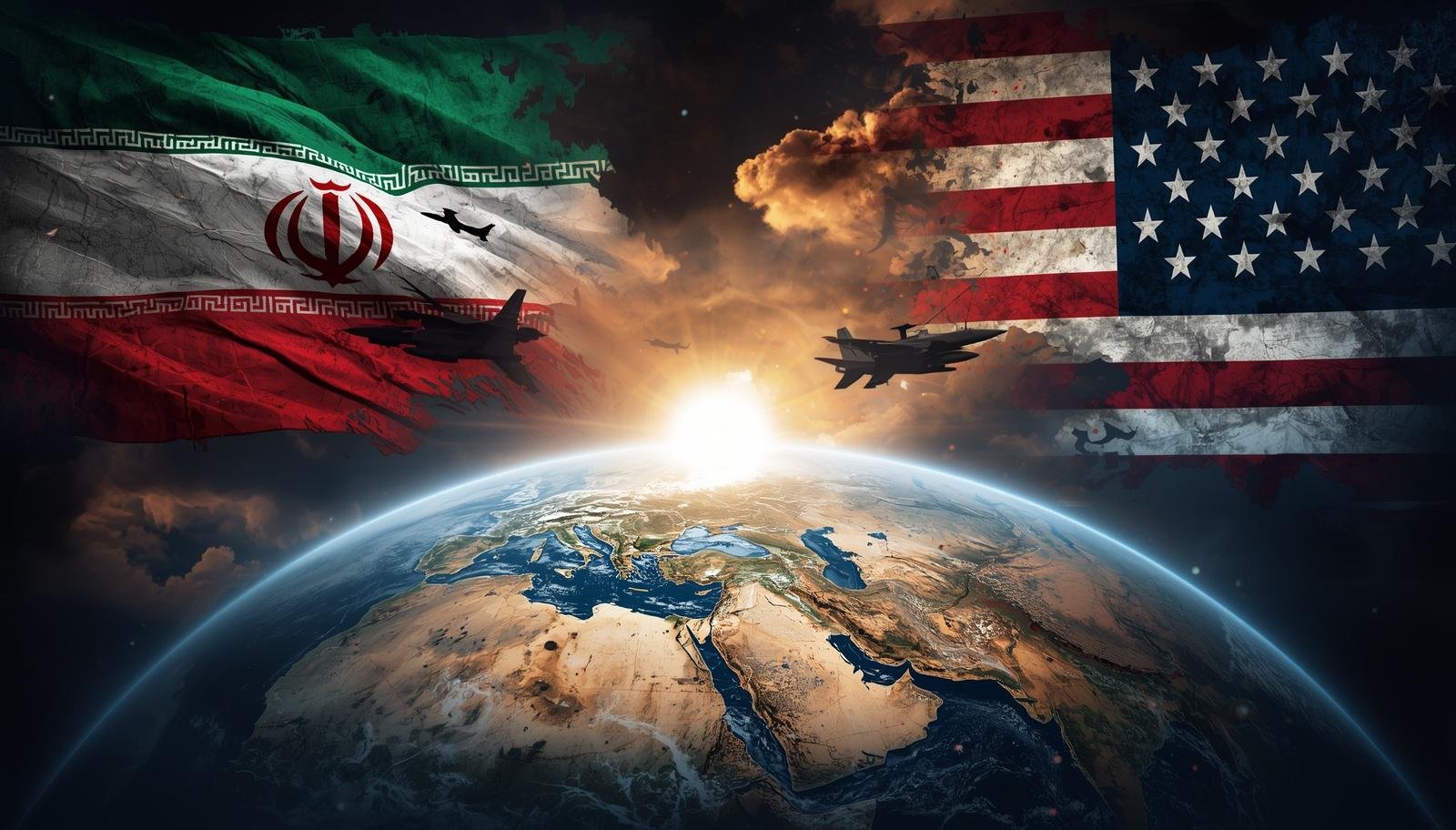
What began in April 2025 as a US diplomatic ultimatum to Iran over its nuclear program escalated — after failed negotiations, Israeli and US airstrikes in June 2025, a further military campaign from February 28, 2026, and the reported death of Supreme Leader Khamenei — into an active armed conflict. Iran responded by closing the Strait of Hormuz, triggering the largest oil supply disruption in recorded history, with Brent crude surpassing $120/barrel. Iran-backed proxy groups including Hezbollah, Hamas, and Iraq-based militias opened additional fronts. As of early April 2026, both sides exchange threats and intermittent dialogue, while the international community, IAEA, and global markets remain on high alert.
Table of Contents
1. Background: The Road to Confrontation
The current Iran–US crisis has deep structural roots. When the Trump administration withdrew from the Joint Comprehensive Plan of Action (JCPOA) in May 2018, Iran responded by progressively dismantling its commitments — expanding uranium enrichment, reducing IAEA monitoring, and developing advanced centrifuges. By early 2025, Iran had enriched uranium to 60% purity, a level the Arms Control Association described as having “no practical civilian application” and placing the country at the threshold of nuclear weapons capability.
Tensions came to a head again in January 2026, when Iranian security forces killed thousands of protesters in a crackdown on mass demonstrations — the largest since the 1979 Islamic Revolution. President Trump responded with threats of military intervention and launched what was described as the largest US military buildup in the Middle East since the 2003 invasion of Iraq, deploying the aircraft carriers USS Abraham Lincoln and USS Gerald R. Ford and associated strike groups to the region.
2. Trump’s Ultimatum and the Negotiation Collapse
In April 2025, President Trump sent a letter to Iranian Supreme Leader Ali Khamenei proposing a new nuclear deal framework. The US demanded full dismantlement of Iran’s nuclear program, a halt to all enrichment, and an end to support for regional proxy groups — with a two-month deadline for compliance. In exchange, the US offered sanctions relief and normalisation of relations, with a warning that military strikes would follow if Iran refused to negotiate.
Four rounds of indirect negotiations followed, with Oman serving as a key mediator. However, on June 9, 2025, Iran formally rejected the Trump administration’s proposal, with Iranian Foreign Ministry spokesperson Esmaeil Baghaei calling it “unacceptable.” The key sticking points were Iran’s claimed right to domestic uranium enrichment, the fate of existing highly enriched uranium stockpiles, and the conditions for sanctions removal. On February 20, 2026, Trump gave Iran a further 10-day deadline to reach a deal “or else the United States would attack Iran.”
3. Iran’s Nuclear Program: What the IAEA Says
The International Atomic Energy Agency (IAEA) confirmed that Iran was enriching uranium to 60% purity — dangerously close to the 90% weapons-grade threshold — and had stored most of this material at an underground tunnel complex at its Isfahan facility. The IAEA also noted the existence of a fourth undisclosed uranium enrichment site at Isfahan, whose operational status and current nuclear inventory remained unknown to inspectors as of late February 2026.
Following the June 2025 US-Israeli airstrikes, Iran suspended IAEA access to sites that were bombed, which the Arms Control Association characterised as a violation of its legally required safeguards agreement. IAEA Director General Rafael Grossi stated in March 2026 that he does not believe “any war” could fully destroy Iran’s nuclear ambitions “unless it was nuclear war,” underscoring the limits of military solutions to the proliferation challenge.
| Parameter | JCPOA Limit (2015) | Iran’s Status (Feb 2025) |
|---|---|---|
| Max enrichment level | 3.67% | 60% |
| Max stockpile (3.67% enriched) | 202 kg | Far exceeded |
| Centrifuge cascades at Natanz | 30 (IR-1) | Expanded (32+ new cascades planned) |
| IAEA monitoring access | Full | Restricted / Suspended at bombed sites |
Source: Arms Control Association, IAEA Reports (2025). All figures are verified institutional data.
4. The Military Escalation (2025–2026)
After negotiations collapsed, Israel and the US launched airstrikes on Iranian nuclear and military sites in June 2025 — a campaign referred to as the “Twelve-Day War.” Iran suspended IAEA access to bombed sites in the aftermath. A second, larger US-Israeli military campaign began on February 28, 2026. Reporting from multiple sources indicates that Supreme Leader Ali Khamenei was killed in these strikes, a development the Wikipedia entry on the 2026 Iran war lists as a pivotal turning point in the conflict.
Key Events Timeline
5. The Strait of Hormuz Crisis
The Strait of Hormuz — a narrow waterway connecting the Persian Gulf to the Gulf of Oman — normally carries ~20% of the world’s oil and significant volumes of liquefied natural gas. Following the February 28 strikes, Iran’s Islamic Revolutionary Guard Corps (IRGC) issued warnings prohibiting vessel passage and began attacking merchant ships. By March 2, 2026, the IRGC officially confirmed the strait was closed. As of mid-March, tanker traffic had dropped to near zero, with over 150 ships anchored outside the strait to avoid attack, and Iran had made 21 confirmed attacks on merchant vessels.
Only Saudi Arabia and the UAE have alternative pipeline routes, and these have limited capacity. QatarEnergy declared force majeure on all exports. On March 21, Trump threatened to “destroy Iran’s power plants within 48 hours” if the Strait was not fully reopened. Iran responded by threatening to close the Strait “completely” if attacked. On March 23, Trump announced a 5-day pause on strikes targeting Iranian energy infrastructure to allow talks — a development Iran denied was occurring.
6. Iran’s Proxy Network Activates
Iran’s regional influence has long been projected through a network of allied armed groups: Hezbollah in Lebanon, Hamas in Gaza, Houthi rebels in Yemen, and Iran-backed militias in Iraq and Syria. Within two days of the February 28 strikes, Hezbollah — just 15 months after the end of its 2024 war with Israel — resumed rocket and drone attacks on northern Israel, drawing an Israeli military response in Lebanon. Iraq-based militias linked to the Islamic Resistance in Iraq claimed drone strikes on US bases in Erbil, and two Houthi leaders told the Associated Press the group intended to resume missile and drone attacks on Red Sea shipping.
By late March 2026, Iran’s military targeted UAE and Bahrain infrastructure directly, striking what it called “American steel industries in Abu Dhabi” and “American aluminum industries in Bahrain,” according to Iranian state TV. Foreign Policy analysts noted that while the proxy groups are broadly acting in solidarity with Iran, each group is also acting partly in its own interest — the level of coordination and strategic command from Tehran remained unclear in the conflict’s early weeks.
7. Global Economic Fallout
The conflict triggered immediate and severe disruption across global financial markets. Brent crude surged 8% — from $71.32 to $77.24/barrel — within two trading days of the February 28 strikes, ultimately exceeding $120/barrel as the Strait of Hormuz closed and Iran targeted Gulf energy infrastructure. The International Energy Agency characterised the disruption as unprecedented in the history of the global oil market. Stock markets declined globally and a bond market sell-off ensued, with Chatham House warning of a “severe scenario” in which oil could reach $130/barrel if the conflict persisted for several months.
The OECD projected that US headline inflation could hit 4.2% in 2026 as a result of the oil price surge, while the G20 group of advanced economies could see inflation reach 4% (Forbes/OECD, March 2026). India — a major oil importer — saw the rupee fall to a record low of 94.79 against the US dollar and was forced to reduce central excise duties on petrol and diesel by ₹10/litre each to cushion domestic prices. The World Economic Forum noted that global economic growth was expected to slow by ~0.3–0.5% in 2026 (estimate) as a result of the conflict.
| Indicator | Pre-Conflict (Feb 2026) | Post-Conflict (Mar–Apr 2026) | Source |
|---|---|---|---|
| Brent Crude (per barrel) | ~$71 | $116–$120+ | Al Jazeera, WEF, Wikipedia |
| US Inflation Forecast (2026) | ~2.5% (estimate) | 4.2% (OECD projection) | Forbes / OECD, Mar 2026 |
| India Rupee vs USD | ~84–85 | 94.79 (record low) | Cervicorn Consulting, Mar 2026 |
| Global GDP Growth Impact | — | −0.3% to −0.5% (estimate) | WEF / Cervicorn, Mar 2026 |
Note: Pre-conflict figures for India Rupee are approximate estimates. Post-conflict data from verified institutional sources.
8. What Comes Next: Three Scenarios
Al Jazeera analysts and Cervicorn Consulting outlined three plausible scenarios for the resolution of the Strait of Hormuz crisis and the broader conflict as of late March 2026:
A diplomatic breakthrough or ceasefire allows the Strait to reopen by late April or May 2026. Brent crude projected to decline to $85–95/barrel. Global economic growth slows ~0.3–0.5% in 2026 (estimate), followed by a recovery. Damage is significant but not structural (Cervicorn Consulting, March 2026).
The conflict persists, oil prices reach ~$130/barrel before declining, and inflation remains elevated. Chatham House warns of “severe economic disruption” echoing the 1970s energy crisis, with risks of stagflation and recession (Chatham House, March 2026).
Iran maintains closure of the Strait as “coercive bargaining” (per scholar Thomas Schelling’s framework), using the threat of prolonged disruption to extract political concessions from the US — without full confrontation. This scenario risks the most severe long-term structural damage to the Gulf GCC economic model (Al Jazeera, March 2026).
Related Articles
- NATO and the US-Iran War: What You Need to Know
- PM Modi on the Middle East War: India’s Stand & Impact
- The Hormuz Crisis: Technical Analysis
- Iran-USA Diplomatic Tensions 2026: A Deep Dive
- Middle East Tensions & Oil Prices 2026: What’s Driving the Market?

4 thoughts on “Iran vs USA war : Escalating Tensions & What’s at Stake”