North Korea Ballistic Missile Launches: Full Guide
A comprehensive look at the DPRK’s escalating missile program, key tests, and global security implications.
April 9, 2026 · 10 min read · Fact-checked against government and UN sources
Executive Summary
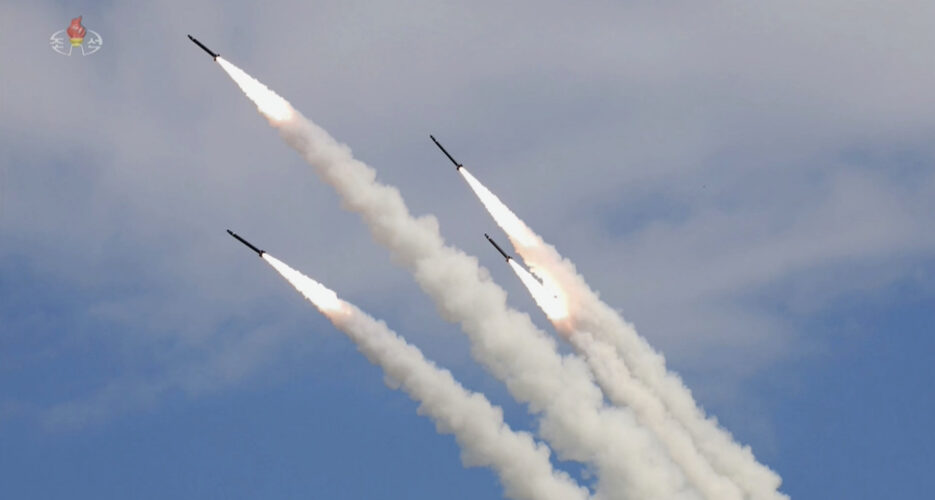
North Korea ballistic missile launches have increased dramatically since 2022, making the Democratic People’s Republic of Korea (DPRK) one of the most active missile-testing states in the world. In 2022 alone, North Korea conducted 69 ballistic missile tests — the highest annual count since records began in 1984.
By 2026, North Korea had added hypersonic glide vehicles, submarine-launched ballistic missiles, and advanced ICBMs to its arsenal. Furthermore, UN Security Council sanctions have largely failed to halt this progress, as China and Russia vetoed new measures in 2022. This guide covers every major development, verified data, and what it means for regional and global security.
Table of Contents
Background: Why North Korea Builds Missiles
North Korea views its ballistic missile program as the ultimate guarantee of the Kim regime’s survival. Pyongyang argues that a credible nuclear and missile deterrent prevents any U.S.-led military intervention — a lesson it draws from the fates of Iraq and Libya. Consequently, missile development has remained a top national priority since the 1980s.
Additionally, missile tests serve as diplomatic signals. Pyongyang typically launches missiles in response to U.S.–South Korea joint military exercises, to mark domestic political anniversaries, or to demand attention before potential negotiations. Therefore, understanding the timing of launches is as important as understanding the technical capabilities they demonstrate.
Key Context
Any launch using ballistic missile technology violates UN Security Council resolutions, regardless of range. This applies to short-range, medium-range, and intercontinental ballistic missiles alike — a position confirmed by the Arms Control Association.
The Strategic Logic of Escalation
Under Kim Jong Un, who assumed power in 2011, North Korea dramatically accelerated its missile and nuclear programs. By contrast, previous administrations had pursued a more ambiguous strategy. Kim declared North Korea a nuclear state in its constitution in 2012, signalling that denuclearization was off the table.
Moreover, North Korea’s military doctrine, as outlined in state media and academic analyses from 38 North, explicitly links nuclear weapons to conventional deterrence. In particular, Pyongyang has stated it would use tactical nuclear weapons to halt any conventional invasion.
Timeline of Key North Korea Ballistic Missile Launches (2022–2026)
The pace of North Korea ballistic missile launches has been unprecedented in recent years. However, 2025 saw a noticeable slowdown in raw numbers, even as the sophistication of individual tests increased significantly.
in 2022
in 2024
(estimate)
in DPRK arsenal
2022: Record-Breaking Year
In 2022, North Korea conducted 69 ballistic missile launches — the highest annual figure since tracking began in 1984, according to Statista. Notably, this included tests of Hwasong-17 ICBMs capable of reaching the continental United States. Furthermore, North Korea tested a submarine-launched ballistic missile (SLBM) variant and multiple short-range ballistic missiles (SRBMs).
2024–2025: Quality Over Quantity
By 2024, North Korea conducted 11 confirmed launch events involving at least 22 missiles, according to Japan’s Ministry of Foreign Affairs. As a result, analysts noted a strategic shift: fewer launches, but more technologically advanced systems. In particular, the October 2024 ICBM test attracted global condemnation.
In 2025, the number dropped further to approximately 15 launches (estimate), as reported by 38 North. However, North Korea unveiled a new ballistic missile submarine and introduced a nuclear-capable air force role, representing a qualitative leap in deterrence posture.
Selected Notable Launches (2024–2026)
| Date | Missile / Type | Key Detail |
|---|---|---|
| Jan 14, 2024 | Hwasong-16A (IRBM) | Intermediate-range ballistic missile test |
| Apr 2, 2024 | Hwasong-16B (IRBM) | Advanced intermediate-range variant |
| Oct 31, 2024 | ICBM | ICBM test; condemned by 10 of 15 UN Security Council members |
| Jan 6, 2025 | Hwasong-16B w/ HGV | Hypersonic glide vehicle (HGV) payload; first 2025 test |
| Oct 22, 2025 | Hypersonic missiles ×2 | First test in five months; timed before Trump’s Asia visit |
| Mar 14, 2026 | ~10 ballistic missiles | Fired toward Sea of Japan; response to U.S.–South Korea drills |
Sources: Wikipedia — List of North Korean missile tests; DW, March 2026
2026 Activity
In March 2026, North Korea fired approximately 10 ballistic missiles toward the Sea of Japan in a single event — directly following a warning from Pyongyang about “dire repercussions” over U.S.–South Korea joint military drills, according to Deutsche Welle. Additionally, Kim Jong Un personally oversaw a 12-launcher multiple rocket drill in mid-March 2026.
Types of North Korean Ballistic Missiles
North Korea operates one of the most diverse ballistic missile arsenals in the world. According to Wikipedia’s analysis of DPRK weapons of mass destruction, the Korean People’s Army Strategic Force operates over 363 ballistic missiles across four main categories.
Short-Range Ballistic Missiles (SRBMs)
SRBMs form the largest segment of North Korea’s arsenal, with approximately 319 in service. The Hwasong-11 series (also called KN-23, KN-24, KN-25) are solid-fuelled and manoeuvrable. Moreover, the KN-25 — a 600mm multiple rocket launcher — was demonstrated again in March 2026, reportedly striking targets 364 km away with claimed precision.
Intermediate and Medium-Range Ballistic Missiles (IRBMs/MRBMs)
North Korea operates approximately 27 intermediate/medium-range systems, including the Hwasong-12 and the newer Hwasong-16B. Notably, the Hwasong-16B was fitted with a hypersonic glide vehicle (HGV) — a manoeuvrable warhead designed to defeat missile defence systems — and tested in January 2025, as confirmed by the Center for Arms Control and Non-Proliferation.
Intercontinental Ballistic Missiles (ICBMs)
North Korea fields approximately 17 ICBMs, primarily the Hwasong-17 and Hwasong-18. The Hwasong-17, first tested in 2022, is a liquid-fuelled monster with a theoretical range exceeding 15,000 km — sufficient to reach any point in the United States. By contrast, the Hwasong-18 is a solid-fuelled ICBM that can be launched more rapidly and is harder to detect before launch.
| Category | Key Systems | Est. Range | In Service (~) |
|---|---|---|---|
| SRBM | Hwasong-11 family (KN-23, KN-24, KN-25) | Up to ~700 km | ~319 |
| IRBM/MRBM | Hwasong-12, Hwasong-16B | 3,000–5,500 km | ~27 |
| ICBM | Hwasong-17, Hwasong-18 | 13,000–15,000+ km | ~17 |
| SLBM | Pukguksong series | ~1,200–2,000 km | Limited |
Source: Wikipedia — North Korea and weapons of mass destruction. All range figures are estimates.
Internal Link
For related analysis, see our guide on North Korea’s Nuclear Weapons Program and our explainer on Asia-Pacific Security Threats. (Publisher note: replace /placeholder-slugs with actual site URLs before publishing.)
North Korea’s Nuclear Weapons Program
North Korea is the tenth country to openly test nuclear weapons, according to Wikipedia. As of 2025, experts estimate its assembled warhead stockpile at approximately 50 nuclear warheads, with sufficient fissile material for 70–90 weapons, as reported by the Arms Control Association.
warheads (2025 est.)
additional warheads
tests (2006–2017)
From Fission to Thermonuclear
North Korea conducted its first nuclear test in 2006 and its most recent in September 2017. Pyongyang claimed its 2017 test involved a thermonuclear (hydrogen) bomb — a claim partially corroborated by seismic data showing a far larger yield than previous tests. Consequently, North Korea became the first state since Pakistan in 1998 to join the nuclear club.
Furthermore, North Korea has invested heavily in miniaturising warheads for ballistic missile delivery. In particular, analysts assess that the DPRK has likely developed warheads small enough to fit on ICBMs, though the precise status of reentry vehicle technology remains uncertain.
Important Note
North Korea also maintains advanced chemical and biological weapons programs, according to the Arms Control Association. Additionally, Pyongyang has not signed the Chemical Weapons Convention.
UN Sanctions and International Responses
The UN Security Council has adopted nine major sanctions resolutions against North Korea, spanning from 2006 to 2017, according to the Arms Control Association. These resolutions target North Korea’s weapons programs through trade restrictions, asset freezes, and travel bans.
Why Sanctions Have Stalled
In May 2022, China and Russia vetoed a U.S.-backed resolution that would have imposed new sanctions following a series of ICBM launches. As a result, no new UN Security Council resolution on North Korea has passed since December 2017, according to AP News. Consequently, the existing sanctions framework has limited enforcement.
However, individual nations continue to impose unilateral sanctions. The United States, European Union, South Korea, Japan, and others have added entities, individuals, and vessels to their own sanctions lists. Moreover, the UN Panel of Experts documented systematic North Korean evasion through ship-to-ship transfers of oil and coal.
Sanctions Scorecard
- 9 major UN Security Council resolutions (2006–2017)
- Last resolution passed: December 22, 2017 (Resolution 2397)
- 2022 U.S.-backed resolution vetoed by China and Russia
- North Korea’s total exports capped at $500 million/year under UNSCR 2371
International Condemnation in 2024
Following the October 2024 ICBM test, 10 of 15 UN Security Council members approved a U.S.-led statement condemning the launch, according to AP News. Nevertheless, without a binding resolution — blocked by Chinese and Russian vetoes — such statements carry no enforcement mechanism.
Regional and Global Security Impact
North Korea ballistic missile launches have reshaped the security landscape across Northeast Asia. South Korea, Japan, and the United States have all significantly upgraded their missile defence infrastructure, intelligence-sharing, and joint military exercises in response.
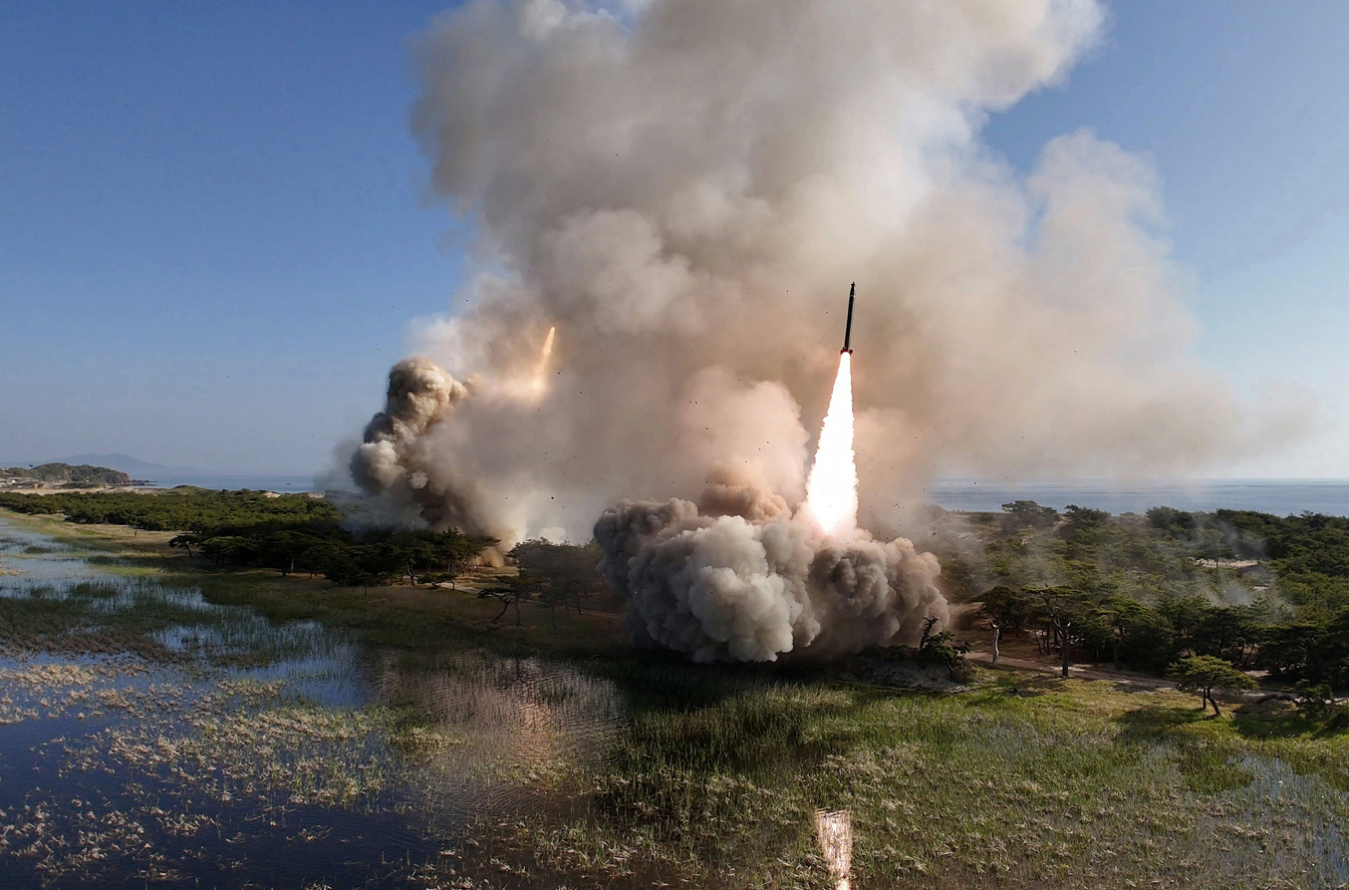
Image: North Korean ballistic missile test, May 2025. Credit: Rodong Sinmun via Korea Risk Group.
South Korea and Japan
South Korea has accelerated development of its Korea Missile Defense (KAMD) system and acquired Terminal High Altitude Area Defense (THAAD) batteries from the United States. Additionally, Japan has expanded its Aegis-equipped destroyer fleet and introduced a counter-strike capability under its revised National Security Strategy of December 2022. Furthermore, Tokyo has invested in extending the range of its existing ballistic missile stocks.
U.S. Extended Deterrence
The United States maintains approximately 28,500 troops in South Korea and has rotated strategic assets — including nuclear-capable B-52 bombers and nuclear-powered submarines — to the Korean Peninsula as deterrence signals. Moreover, the Washington Declaration of 2023 established a new Nuclear Consultative Group between the U.S. and South Korea.
North Korea–Russia Dimension
In 2024–2025, multiple credible reports alleged that North Korea supplied artillery shells and potentially ballistic missiles to Russia for use in Ukraine. Consequently, Western governments warned that the Russia–DPRK military relationship was deepening, potentially providing Pyongyang with access to advanced Russian technology in return.
Frequently Asked Questions
Sources & References
- 1. Japan Ministry of Foreign Affairs — Missile Launches by North Korea (Jan. 2024–)
- 2. 38 North — New Missiles But Fewer Launches, January 2026
- 3. Arms Control Association — Arms Control & Proliferation Profile: North Korea
- 4. Arms Control Association — UN Security Council Resolutions on North Korea
- 5. AP News — North Korean ICBM Condemned by UN Security Council, November 2024
- 6. Deutsche Welle — North Korea Fired 10 Ballistic Missiles, March 2026
- 7. Center for Arms Control & Non-Proliferation — North Korea Missile Launch Activity Fact Sheet, Dec 2025
- 8. Wikipedia — List of North Korean Missile Tests
- 9. Wikipedia — North Korea and Weapons of Mass Destruction
- 10. Statista — Ballistic Missile Tests by North Korea by Results
- 11. Statista — Ceasefire Explained: Meaning,Process & 2026 Updates
- This article was last updated April 9, 2026. All statistics are verified from listed sources. Estimates are marked with ~ or (estimate).



One thought on “North Korea Ballistic Missile Launches: Full Guide”