Spiti Valley Opening 2026:
Season Guide & Key Monastery Trek
Your complete road-by-road, month-by-month guide to the 2026 season reopening.
Executive Summary
Spiti Valley has reopened for the 2026 season. The Shimla–Kinnaur–Kaza route (NH-05) is accessible now and remains the only reliable road into the valley through April and May. The Manali–Kunzum Pass route remains closed until approximately mid-June 2026. April is a rare window of serene, snow-dusted landscapes and minimal crowds — perfect for visiting Key Monastery (Kye Gompa), exploring Tabo, and driving the classic Hindustan Tibet Highway before the summer rush. Daytime temperatures in April range from approximately -5°C to +18°C depending on altitude. No permit is required for Indian nationals; foreign nationals require an Inner Line Permit.
Table of Contents
2026 Road Status: What Is Open Right Now
As of April 2026, Spiti Valley is accessible via one primary route. The Shimla–Kinnaur–Kaza Highway (NH-05), also called the Hindustan Tibet Highway, is open and passable, though travellers should verify conditions 24–48 hours before departure due to spring snowmelt and occasional road blockages at higher stretches.
The Manali–Rohtang–Kunzum Pass–Kaza route remains closed. The Lahaul & Spiti District road authority confirmed in March 2026 that the Keylong–Kaza section is closed, consistent with the historical pattern of this route reopening between mid-June and early July.
Road Status Snapshot — April 2026
- Shimla → Kinnaur → Kaza (NH-05): Open (verify daily conditions)
- Keylong → Kaza (via Kunzum Pass): Closed — expected reopening mid-June 2026 (~estimate)
- Manali → Rohtang Pass: Closed until ~late May 2026 (estimate)
- Kaza → Key Monastery (14 km): Open, accessible by road
Official updates: hplahaulspiti.nic.in/road-status/
Spiti Valley in April: What to Expect
April sits at the edge of spring and late winter in Spiti. At valley level near Kaza (~3,650 m), daytime temperatures can reach 7°C to 18°C, while nights drop to -5°C or below. At higher villages like Kibber (4,270 m) and Langza (4,420 m), overnight lows regularly hit -10°C to -15°C. Snow is still present on most high-altitude roads and surrounding peaks.
The single biggest appeal of April travel is low footfall. Spiti in peak season (July–September) is increasingly crowded; April offers the same stark beauty — snow-walls, frozen rivers thawing, ancient monasteries — with far fewer visitors. There are approximately 13 hours of daily sunlight, favouring photographers and trekkers.
April Weather at a Glance
| Location | Altitude | Day Temp (approx.) | Night Temp (approx.) |
|---|---|---|---|
| Kaza (base) | 3,650 m | 7°C – 18°C | -5°C to 0°C |
| Key Monastery | 4,166 m | 2°C – 12°C | -8°C to -5°C |
| Kibber / Langza | 4,270–4,420 m | 0°C – 8°C | -12°C to -5°C |
| Tabo / Nako | 3,050–3,625 m | 10°C – 20°C | -2°C to 3°C |
Sources: MakeMyTrip climate data, climate-data.org, YouTube travel guide April 2026. All values approximate.
April Travel Reality Check
Many guesthouses and cafes in Kaza are open from April onward, but expect limited options compared to summer. Carry cash — ATMs in Kaza can be unreliable, and the nearest well-stocked bank is in Reckong Peo. Fuel up at every opportunity; petrol stations are sparse beyond Shimla.
Key Monastery (Kye Gompa): Complete Trek & Visit Guide
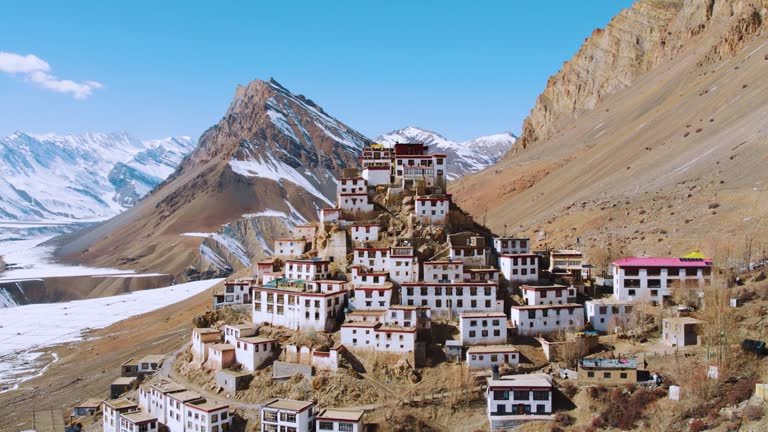
Key Monastery — locally called Kye Gompa — is the largest and most iconic Buddhist monastery in Spiti Valley. Founded in the 11th century, it perches on a dramatic rocky hilltop at 4,166 m, overlooking the braided Spiti River. Its tiered white-washed structure, layered over centuries, resembles a medieval fortress-city. The monastery houses over 300 monks, a 1,200-year-old collection of thangkas, scriptures, and ancient weapons.
How to Reach Key Monastery
The monastery is 14 km from Kaza Town, a 30–40 minute drive on a road that begins paved and turns into a steep, winding track near the summit. There is no dedicated trekking trail in the traditional sense; most visitors drive to a parking area and walk the final short climb on foot. For adventure seekers, a longer trek from Kaza to Key (approximately 8–10 km on foot) is possible across the valley floor, gaining ~500 m in elevation — best attempted in June onwards when the trail is snow-free.
What to See & Do at Key Monastery
- Ancient prayer halls: Multiple interconnected halls housing centuries-old butter-lamp murals, thangkas, and manuscripts
- Rooftop sunrise viewpoint: Among the most dramatic vistas in Himachal Pradesh — the entire Spiti valley framed by snow peaks at dawn
- Monk interactions: Key is an active monastery; morning and evening prayers (pujas) are open to respectful visitors
- Guitor Chaam festival: Annual masked dance festival held in June–July; one of Spiti’s most vibrant cultural events
- Onward circuit: From Key, continue 6 km to Kibber village (4,270 m), one of the highest inhabited villages in the world accessible by road
Monastery Etiquette
Always walk clockwise around prayer wheels and stupas. Remove shoes before entering prayer halls. Photography of monks requires permission. Dress conservatively — shoulders and knees covered. Donations, however small, support the monastery’s preservation work.
7-Day Itinerary: Shimla to Kaza via Kinnaur (April 2026)
This is the recommended route for April 2026, following NH-05 (Hindustan Tibet Highway). The circuit takes 7 days at a comfortable pace, with proper acclimatisation built in. Note that the return leg via Manali remains closed in April; plan to return via Kinnaur–Shimla or fly from Kullu (nearest airport).
| Day | Segment | Distance | Highlights |
|---|---|---|---|
| Day 1 | Shimla → Narkanda → Rampur | ~175 km | Apple orchards, Narkanda market, Sutlej River gorge |
| Day 2 | Rampur → Reckong Peo → Kalpa | ~100 km | Kinnaur Kailash views, Kalpa village, apple blossom (April) |
| Day 3 | Kalpa → Nako → Tabo | ~140 km | Nako Lake, Sumdo (Spiti entry), Tabo Monastery (996 AD) |
| Day 4 | Tabo → Dhankar → Kaza | ~70 km | Dhankar monastery cliff-top, Pin Valley junction, arrive Kaza |
| Day 5 | Kaza Base Day — Acclimatise | — | Explore Kaza market, rest, short walk to nearby viewpoints |
| Day 6 | Kaza → Key Monastery → Kibber | ~20 km | Key Gompa sunrise, monk morning prayers, Kibber village walk |
| Day 7 | Kaza → Langza → Hikkim → return | ~40 km loop | Hikkim (world’s highest post office), Komik village, fossil hunting |
April Note on Higher Villages
Roads to Langza, Hikkim, and Komik may be partially snow-covered in April. Confirm local road conditions in Kaza before attempting these loops. A 4×4 or high-clearance vehicle is strongly recommended for this season.
Month-by-Month Season Calendar
Understanding which months suit which type of traveller is essential for planning. The Manali route’s closure and Kunzum Pass conditions are the dominant variables across the season.
| Month | Route Access | Crowds | Best For |
|---|---|---|---|
| April | Shimla–Kinnaur only | Very low | Photography, winter landscapes, solitude |
| May | Shimla–Kinnaur; Manali side opening | Low–Medium | Pre-season, spring wildflowers |
| June–July | Both routes open (~mid-June) | High | Full circuit trips, Chandratal, Guitor Chaam festival |
| Aug–Sept | Both routes open | Peak | Trekking, highest passes, best weather |
| Oct–Nov | Shimla–Kinnaur; Manali route closing ~Oct | Low | Autumn colours, fewer tourists, crisp skies |
Permits, Documents & Entry Rules
Indian nationals do not require any permit to visit Spiti Valley or the Kinnaur Valley when travelling via the Shimla side. Carrying a valid government-issued photo ID (Aadhaar card, voter ID, driving licence, or passport) is sufficient for hotel check-ins and any local checkposts.
Foreign nationals must obtain an Inner Line Permit (ILP) before entering restricted areas along the Kinnaur–Spiti corridor. This permit is obtained from the District Magistrate’s office in Shimla, Reckong Peo, or Delhi. A travel agency letter, passport and visa copies, and a defined itinerary are required. The permit fee is nominal (~Rs 250–400, estimate) and processing is typically same-day.
Permit Quick Reference
| Indian Nationals | No permit required. Valid photo ID mandatory. |
| Foreign Nationals | Inner Line Permit required. Apply at DM office (Shimla / Reckong Peo / Delhi). |
| Rohtang Pass (Manali side) | Vehicle permit required (when route is open, mid-June onwards). |
| Documents to Carry | Aadhaar / Passport, hotel booking confirmations, emergency contacts. |
Essential Travel Tips for 2026
High-altitude travel in April demands preparation beyond a standard Himalayan trip. Acclimatise for at least one full day in Kaza before ascending to Key Monastery or higher villages — altitude sickness is a real risk at 4,000+ metres, particularly for travellers arriving quickly from the plains.
Packing Essentials for April
- Thermals and layering system — temperatures swing 20°C+ between day and night
- Down jacket and windproof shell — non-negotiable above 4,000 m
- Sunscreen SPF 50+ and UV-protection sunglasses — UV intensity at altitude is severe
- Altitude sickness medication (Diamox/Acetazolamide) — consult your doctor before travel
- Portable power bank and solar charger — power cuts are frequent in remote areas
- Cash (minimum Rs 10,000–15,000) — ATMs in Kaza are unreliable, no card payments beyond Reckong Peo
- High-clearance 4×4 or SUV — essential for April road conditions; avoid hatchbacks and sedans
- Offline maps (Maps.me or OsmAnd) — mobile network drops out frequently on the Kinnaur route
Health & Safety
- The nearest hospital with adequate facilities is in Reckong Peo (~180 km from Kaza); the Kaza Community Health Centre handles basic emergencies only
- Drink minimum 3–4 litres of water daily to mitigate altitude sickness symptoms
- Do not ascend more than 500 m per day once above 3,000 m
- Travel insurance covering high-altitude rescue (helicopter evacuation) is highly recommended
Official Road Status & Verification
Always check the official Lahaul & Spiti District road status portal at hplahaulspiti.nic.in/road-status/ 24–48 hours before any leg of your journey. The Kinnaur District administration also posts updates; local guesthouse owners in Tabo and Kaza are the most reliable real-time source for current conditions.